

The District of Hudson’s Hope is embarking on an exciting journey to replace the existing Community Hall and Hudson’s Hope Public Library with a new and innovative Multi Use Gathering Centre (MUGC). This state-of-the-art facility aims to serve as a community hub that fosters engagement, learning, culture, tourism, health and wellness, and personal growth for all residents and visitors.
Open House Presentations:
September 22, 2026 – Open House
September 22, 2026 Open House Presentation
September 22, 2026 Open House Financial and Vote Presentation
March 12, 2026 – Open House
An Open House was held on March 12, 2026 to share the project’s progress and outline next steps in the development of the Multi‑Use Gathering Centre.
An Open House was held on June 3, 2025 to present the initial vision for the new facility and review potential location options. The slides from this session are available below:
Open House Slides – June, 2025
Open House Presentation – June, 2025
November 6, 2024 – Vision Workshop
A Multi‑Use Gathering Centre Vision Workshop was held on November 6, 2025 at Hudson’s Hope School, where participants helped shape the guiding vision for the new building.
Why is this project needed?
This project is needed for several important reasons: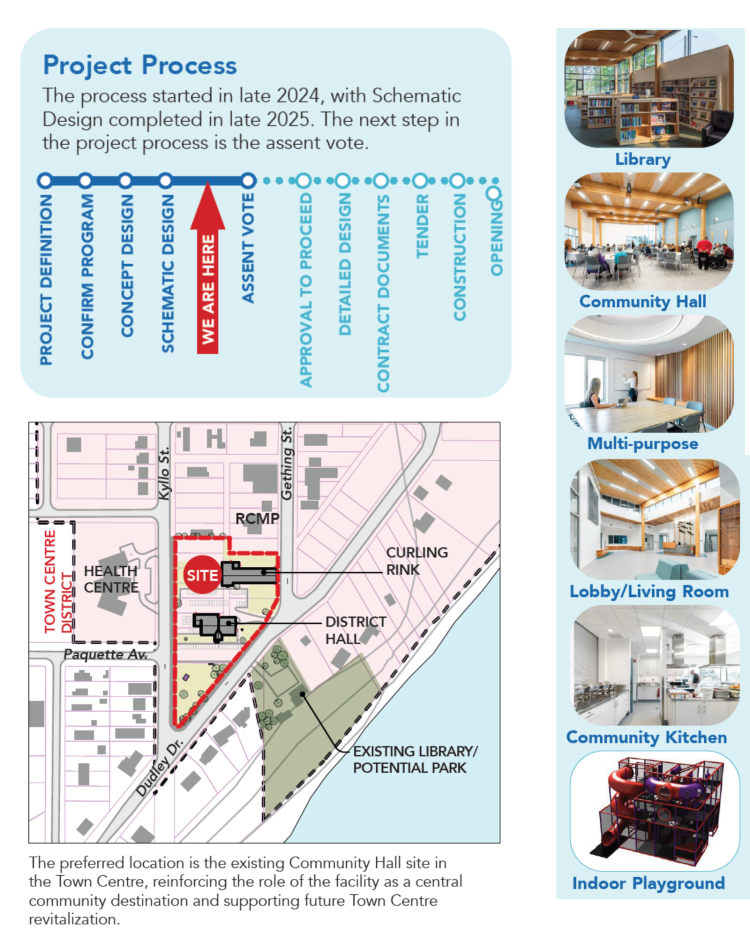
1. Closure of the Community Hall – The community hall has recently been closed after a series of inspections from Northern Health and building identified health, building code, and fire violations, including a number of ‘big ticket” items that need to be repaired or replaced.
2. Increased Community Demand: There is a growing need for a multi-use gathering space that accommodates the diverse needs of our community. With the existing community hall closed, there is insufficient and limited space to hold events and community programming.
3. Enhanced Library Services: The current library has ongoing maintenance and building envelope issues and lacks sufficient space, causing it to operate at or beyond capacity. Expanding the library is essential to provide a reliable space for programs, workshops, and community events. Renovation of the library in place would result in a loss or reduction of services during the construction period, while a new facility would minimize disruption.
4. Modernization: The community hall and the library were built in 1969, and their facilities do not meet modern accessibility standards, technology needs, or community expectations. A new multi-use gathering center can provide updated amenities that support a wide range of activities and services.
5. Economic and Social Benefits: A multi-use gathering center can serve as a hub for social interaction, fostering community engagement and cohesion. It can stimulate local economic growth by attracting events, promoting local businesses, and serving as a venue for community gatherings.
6. Flexibility and Multi-functionality: A dedicated center can be designed to support a variety of functions, from community meetings and educational programs to social events and cultural activities, providing a versatile space that adapts to the needs of the community.
7. Cost-Effectiveness: Renovating the existing Community Hall would be more expensive than a complete replacement, especially considering its current condition. Investing in a new facility would provide a modern solution at a more sustainable long-term cost.
Overall, this project will enhance the community’s infrastructure and improve residents’ quality of life by providing essential spaces for gathering, learning, and collaboration.
How will this project be funded?
Funding for this project will be secured through borrowing and grants.
1. Borrowing: A portion of the project’s funding will come from borrowing. This approach allows the community to access necessary funds upfront to cover the initial costs of construction and development, while spreading repayment over time, ensuring minimal immediate financial impact on taxpayers.
2. Grants: The District will be applying to various grant opportunities from provincial and federal sources, as well as from private organizations that support community development, libraries, and public spaces. These grants can provide significant financial support and reduce the overall cost burden on the community.
By leveraging these funding sources, the District aims to create a financially viable plan that minimizes the impact on residents while ensuring the successful completion of the project. Ongoing efforts will be made to identify new funding opportunities and ensure transparency and accountability in the use of public funds.


